Modernize your Plex ERP without shutting down production.
Thirteen years modernizing Plex and legacy ERP for manufacturers. We specialize in the aging, over-customized systems most firms would rather replace than untangle, and we move them to the cloud in stages, without stopping production.
- Full Plex lifecycle: implementation, customization, integration, migration, support
- Staged cutover: old and new run in parallel, production never stops
- Direct access to the engineers doing the work, no account layer
- Fixed cost and timeline in writing, within one business day



Make your Plex ERP work the way your operation actually runs.
After a decade of production use, most Plex and legacy ERP systems drift from the business. These are the problems we modernize, migrate, and integrate around, without a risky rip-and-replace.
Fragmented data
Orders, inventory, and quality data spread across Plex, spreadsheets, and disconnected tools, re-keyed by hand at the end of every shift.
Undocumented customizations
Years of Plex customizations nobody can explain, where every change is a risk and the one person who understands it is nearing retirement.
Weekend-only deployments
Releases pushed on weekends because nobody trusts the ERP to survive a change during production hours.
Brittle integrations
Fragile connections between Plex, your MES, EDI, and finance systems that break quietly and surface as bad data downstream.
Aging infrastructure
An on-premise stack with a growing bill, holding back a system the business can't afford to stop but can't keep running as-is.
Upgrade uncertainty
Modernization stuck on hold because a full ERP replacement means a year of disruption the operation can't absorb.
A 15-year-old Plex ERP, cloud-native in 18 weeks.
A $200M automotive parts manufacturer had run the same ERP for 15 years. It worked, but every change was a risk. Deployments happened on weekends, and the engineering team spent more time managing infrastructure than building on it.
We migrated it in stages, two services at a time, with old and new running in parallel until each piece proved out. Zero downtime through the entire process. The team got an environment they could work in, and the CFO got $2.4M back in year one.
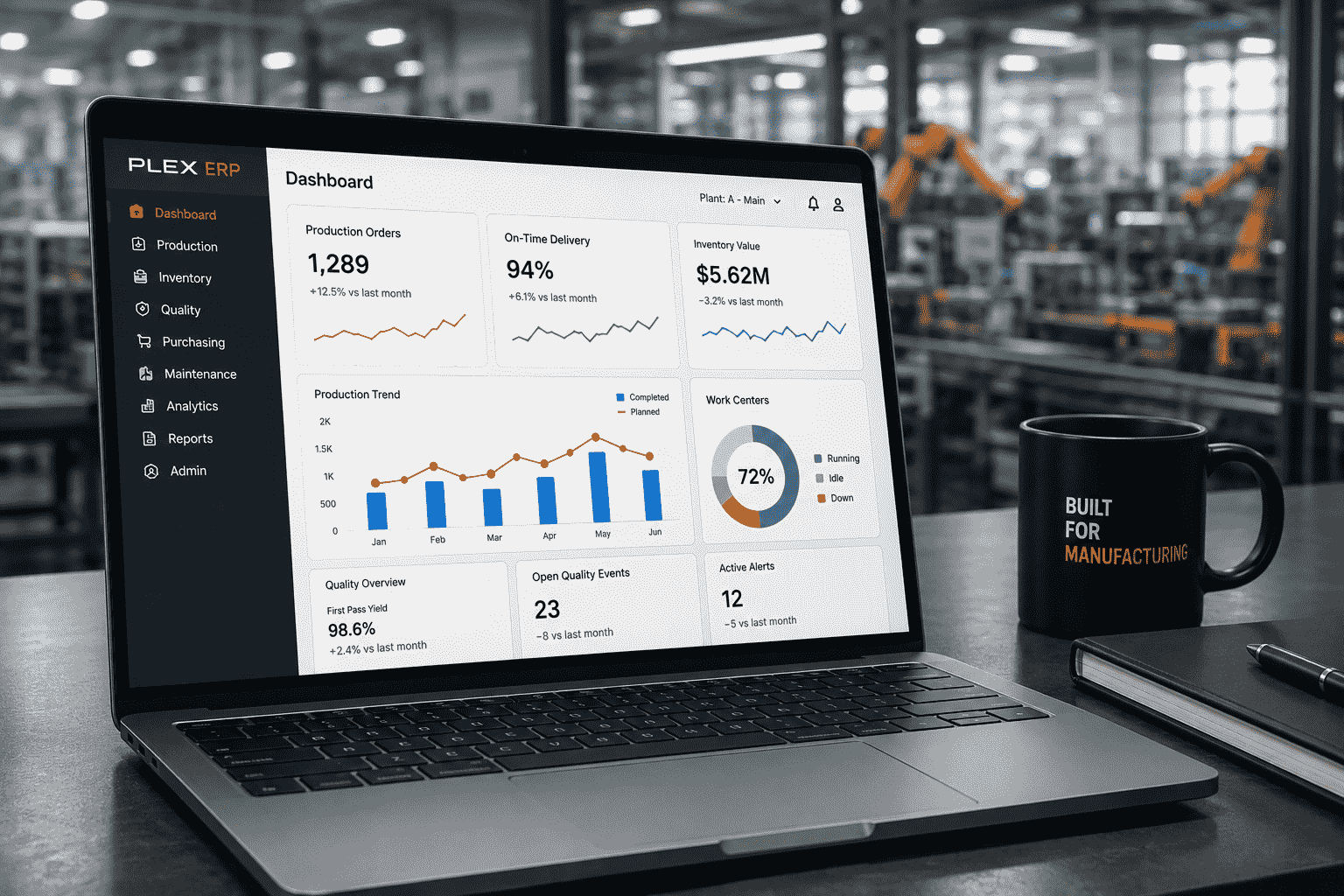
Plex modernization for a food and beverage manufacturer.
A multi-plant food and beverage manufacturer ran production in Plex, but quality, lot traceability, and compliance data still lived in spreadsheets. Audit prep took weeks, and tracing a single lot across plants was slow. We integrated Plex QMS with the shop floor and supplier data, automating lot genealogy and compliance reporting.
Signs your Plex ERP is ready for modernization.
Not every ERP needs work. If yours is stable, well documented, and keeps up with the business, leave it alone. Modernization usually pays off when a few of these are true at once:
- Upgrades keep getting deferred because no one is confident the system will come back up.
- Deployments only happen after hours or on weekends.
- Integrations between your ERP, MES, and finance systems break, and no one owns the fix.
- Monthly reporting still depends on someone rebuilding spreadsheets by hand.
- The people who understand the customizations are leaving, and the knowledge is not written down.
- Infrastructure cost keeps rising faster than the value the system returns.
- A new plant, product line, or acquisition is waiting on a system that cannot flex to fit it.
If two or three of these sound familiar, a staged modernization is usually cheaper and less disruptive than living with the system another year. We will tell you honestly which of these apply to you in the assessment.
A senior engineer reviews your Plex or legacy ERP and replies within one business day. No obligation.
Plex ERP services, from implementation to migration.
Full-lifecycle Plex ERP consulting across the Plex Smart Manufacturing Platform, including MES, QMS, and Supply Chain Planning. Most firms do new rollouts or ongoing support, not both. We've done implementation, customization, integration, and migration for over a decade, so the customization in your environment is usually something we've already untangled somewhere else.
Plex ERP implementation
New Plex Smart Manufacturing Platform rollouts scoped to your routings, BOMs, and shop-floor reality, not a template that gets patched for two years after go-live.
Legacy ERP migration & cloud modernization
Staged migration to cloud-native infrastructure, two services at a time. Old and new run in parallel until each piece proves out. Production never waits on a cutover.
Customization & integration
Custom Plex modules, plus integration with your MES, QMS, EDI, finance, and supply-chain systems, so orders, inventory, and quality data stop living in spreadsheets.
Optimization & support
Underused Plex modules, slow screens, workarounds that became process. We optimize the instance you have before recommending the one you don't need.
One source of truth, not five spreadsheets.
Most manufacturers don't run Plex alone. It sits alongside an MES, EDI feeds to customers, finance systems, and a supply chain that never stops moving.
We connect them so data flows once and stays consistent everywhere. Orders, inventory, and quality live in one system, instead of being re-keyed across tools at the end of every shift.
Why not just call the biggest firm?
13 years in Plex, not around it
Not a generalist shop with a Plex practice bolted on. Implementation, modernization, and migration have been the work since 2013.
We take the migrations others decline
Undocumented customizations stacked over a decade are our specialty, not our exception. Send us the system your last consultant backed away from.
The engineers you meet are the engineers you get
No account-manager layer. The senior team that scopes your migration is the team that writes the code.
Cost and timeline in writing, in one day
A fixed-scope proposal within one business day. You know what it costs before you commit, not after a six-week discovery engagement.
Zero downtime is the constraint, not the goal
Every migration is scoped around continuous production from the first conversation. Weekend cutovers are the thing we remove, not the plan.
Working software every two weeks
Not a status deck. A running system your team can log into, visibly more modern every sprint.
A staged migration, with zero downtime.
-
1
Assess & scope
We map your Plex instance, customizations, and integrations, then tell you honestly what a migration would take.
-
2
Fixed-scope proposal
Cost, timeline, and what done looks like, in writing, within one business day.
-
3
Migrate in stages
Two services at a time. Each is built, validated, and proven on cloud infrastructure before the next begins.
-
4
Cutover & handover
Traffic moves once each service is proven. Documentation and training leave your team owning the system.
Old and new run in parallel. Each service only carries live traffic once it is proven, so production never stops and there is no big-bang cutover.
What shapes your timeline and cost.
A near-standard instance moves quickly. Years of undocumented customization take longer, because each one has to be understood before it is migrated or retired.
MES, QMS, EDI, finance, and supply-chain connections each add scope. The more real-time and two-way they are, the more careful the sequencing.
Clean, well-structured data migrates predictably. Duplicated, inconsistent, or partially manual data needs cleanup before it moves.
A single-site rollout is simpler than a multi-plant network with different processes, languages, and local compliance rules.
Regulated environments need audit trails, validation, and documentation built in from the start, which is planned work, not overhead added later.
Plex ERP questions, answered.
Do we need to replace our Plex ERP to modernize it?
Can you work with our existing Plex and Rockwell Automation setup?
How long has mVerve worked with Plex?
Can Plex integrate with our MES, QMS, and supply chain systems?
How long does a typical Plex ERP migration take?
Will our operations go down during the migration?
What happens after go-live?
How much does a Plex ERP project cost?
Find out what your migration would actually take.
Tell us about your current system. You'll hear back within one business day with a real assessment, not a sales sequence.